Programming PLCs for industrial automation
SIND Process Control · Bucharest, Romania · 2020
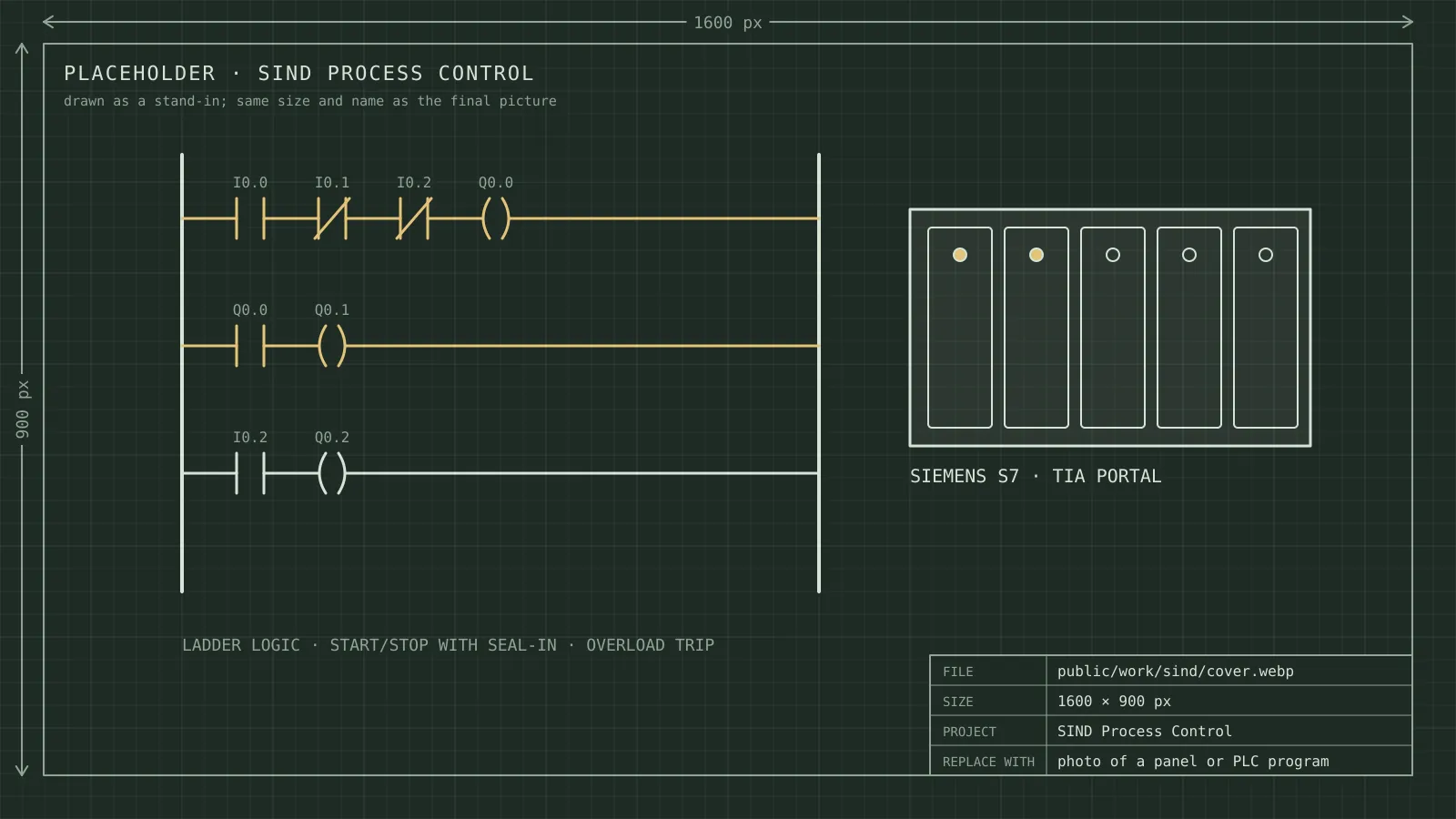
PLCs (programmable logic controllers) are the small, tough computers that run factories: conveyor belts, pumps, valves, packaging lines. In the automation department of SIND Process Control, I programmed Siemens SIMATIC S7 PLCs for 3 projects running at the same time, in a team of 5 engineers.
In numbers
- Time: production data live instead of written down at the end of an 8-hour shift, and about 3 days of commissioning on site per line.
- Money: for one client, about 6 hours less downtime a month, worth around €3,000.
- Errors: 100% of inputs and outputs tested before start-up, 0 safety incidents, and 80% of reported issues fixed within 24 hours.
- Adoption: running at 3 client sites, used by about 30 operators.
- Scale: 3 projects at once, 12 machines and about 400 inputs and outputs, in a team of 5 engineers.
The work
- PLC programs in Siemens TIA Portal, in ladder logic and structured text.
- Automated data collection from the machines, so the client saw production data live instead of writing it down at the end of the shift.
- Commissioning on site: testing every input and output with the electricians before the line started.
- Support: 80% of the issues clients reported were fixed within 24 hours.
The most important rung
The demo above shows the pattern every automation engineer learns first: start and stop with a self-holding contact. Start turns the motor on, the motor’s own contact keeps it on, and Stop breaks the circuit.
The Stop button is wired normally closed. If a wire breaks or comes loose, the circuit opens and the motor stops. The machine fails safe. Small details like that are the difference between a program that works on the desk and one that is safe on the floor.
Why it matters now
Code that moves a real motor doesn’t forgive mistakes. That discipline (test every case, assume the wire will break) is in everything I build, including the AI tools.